
Closed Doors

I posted this account in March, then swiftly took it down, worried it might interfere with the positive connections I’d been forging. However, many months have passed with no change, so I’ve decided to rewrite and publish it again. After more than two years of unemployment, hundreds of job applications, and several genuinely absurd setbacks, I feel the need to document what has happened — not to attack anyone, but simply to leave a record.
History & Background
I’ve spent more than a decade building experience in nature and heritage. From 2012-2014, I gained voluntary experience in practical conservation as well as heritage preservation. Then, at twenty-one, I returned to education and completed a two-year Level 3 Extended Diploma in Countryside Management, earning a Distinction Star. Later, I finished a BSc (Hons) in Wildlife Ecology and Conservation with a First. Sadly, when the pandemic arrived, I struggled to find stable work and accepted two short contracts: ecological consultancy across the South of England, followed by HS2 Great Crested Newt mitigation.
Consultancy is widely regarded as a problematic field. Feeling this early on, I ended up forsaking five years of study in the hopes of shifting my career towards writing and communication. To that end, I managed to get my foot somewhat in the door as a freelance English editor for science journals just before undertaking my MA English Literature [by Research] (Distinction and postgraduate award), which partly focused on environmental philosophy.
Now, I am fully aware a postgraduate in literature rarely leads directly to stable employment. I didn’t pursue it under any illusion that it would, though I had hoped that the oft-touted ‘transferrable skills’ would come into play given that the degree was based on extensive independent and rigorous research. While the degree has helped in some respects, it also places me in an awkward space insofar as I’m neither a pure humanities applicant nor a straightforward science applicant. There are several other serious issues I’ve faced as a result of finishing the MA Res, but this isn’t the place to go into detail.
To return to the broader picture, my background is broad and varied. It includes practical countryside management, ecological fieldwork, habitat/species report writing, data analysis, scientific editing, and humanities research. Outside of formal employment, I currently volunteer as an Associate Editor/Outreach Manager and Lead Editor for a peer-reviewed journal and microsite, respectively. I also have multiple writing credits and go out of my way present work at festivals as an independent scholar. Finally, I’ve created websites and produced videos relating to ecocentrism, literature, and heritage. Despite all of this, at thirty-two years of age, I seem unable to get any job, let alone one in the environmental sector. Everywhere I turn, I find closed doors.
Intended Career Paths & Case Studies
I’ve applied for many different types of jobs, but I want to start with the three areas associated with nature and heritage, broadly construed. Naturally, it’s here that the main issues lie.
Ranger/General Outdoor Work
Getting into a practical outdoor position is difficult. Although I trained extensively in conservation and have a lot of rural experience, I’ve not been engaged in that kind of work for years. I accept that my skills and knowledge have faded somewhat. My goals have shifted too, making this route even more complicated. That said, you would think that my background would still hold weight. Recent years have shown otherwise.
Example #1:
Early on, I interviewed for a heritage role within the education sector that closely matched the work I’d done during my year of volunteering at Butser Ancient Farm. I distinctly recall getting into an impassioned conversation about prehistory with the employer and even discussed the opportunity of doing woodland management tasks, even though that wasn’t part of the remit at all. An interview like this should land a job, but it didn’t. Also, it must be said that the role required a two-hour drive and involved cleaning toilets, which I would have done.
Example #2:
I applied to work at a nature reserve that had deep personal significance for me. After preparing intensely for this job, including revising the site’s management plans and recording notes to listen to in the car, I was rejected, albeit as one of the outstanding candidates. This was a job I could potentially have secured in 2015, and I find it frustrating that, theoretically, someone who had just come out of a diploma, for instance, might have taken the role.
During this interview, an ecologist was present. He joked that I could potentially do his job, implying that the ranger role I’d applied for was less technical and/or demanding. (Similar comments have in fact been repeated in other interviews). Ironically, shortly after, I learned I had an interview at an ecological consultancy. If successful with both jobs, however unlikely, I was going to take the nature reserve position instead of working for the consultancy, despite the lower pay. That’s how I think and act. I don’t care about money, only good and meaningful work.
Consultancy
Returning to ecological consultancy has been equally difficult, despite the entirety of my BSc being geared towards this one field. I have been shortlisted occasionally, but I’m usually competing against MSc graduates, which is fair enough. However, it must be said that several students from my BSc cohort, some of whom put in far less effort, are now principal ecologists. Meanwhile, I’m advised by Universal Credit to apply to work in coffee shops.
I don’t have room here to expand on the problems within consultancy. Suffice it to say, many people feel consultancy is neither fulfilling nor particularly beneficial to nature.
Example #3:
I attended an interview where I was essentially told that I knew what I was doing — because I did. The framing of the call highly suggested that I already had the position and that I was being filled in on the details. The job represented a chance to return to what I originally trained for. I had even told friends and family the good news. Shockingly, this one chance to return to gainful employment was withdrawn because of an internal quota issue. There was nothing I could have done.
Communications
As for communications, I would genuinely love to work in this area, particularly for a nature NGO. But I’ve been rejected for every role, including the most basic ones — even those involving straightforward tasks like proofreading newsletters. Now, it has to be said that the voluntary editorial and outreach work I do is often more complex than many of the jobs I’ve applied for in the past. I wonder if I’m simply not able to enter this field because I don’t have a formal marketing or journalism degree, which would be ridiculous because those qualifications aren’t even subject-specific, i.e., related to the environmental sciences or humanities.
Example #4:
I received a rejection for a nature comms role despite working with the organisation on a project closely linked to the position in question. I also spent days on my application and got help from someone connected in the field. Fair enough, many people have more experience than me, but I would have expected more than a few sentences in the rejection email.
Example #5:
Now for the most serious rejection. This one stands out as the most baffling and contradictory moment in my search for employment. Indeed, this case study is related to the last job I applied for.
I have been continually barred from employment in nature communications. My background in ecology, MA Res in English literature (focused on Earth-centred sacrality), experience editing scientific papers, and even my voluntary editorial/outreach work haven’t mattered. I am not considered experienced enough for paid communications work. But I was once offered an entry-level nature communications job. I now wish I hadn’t even been given the opportunity because it has left me utterly confused and downtrodden.
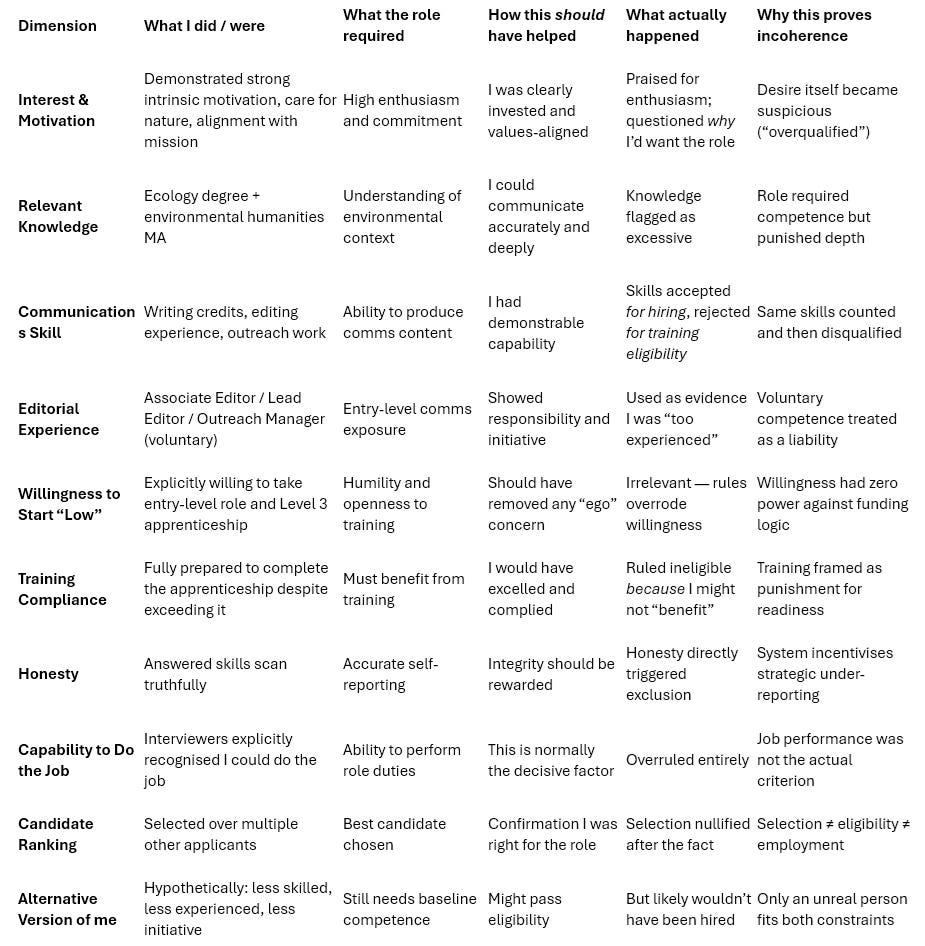
The organisation could see my enthusiasm, my academic achievements, my voluntary work, and my commitment to nature and heritage. All the things that had been dismissed elsewhere as ‘not enough experience’ were suddenly so strong that they wondered why I would even want this role. In other words, I went from being insufficiently experienced across the sector to almost overqualified the moment someone actually looked at my profile carefully and gave me the chance to be myself. I even got emotional during the interview.
But because the job was tied to a Level 3 apprenticeship, I had to complete a mandatory skills scan. I answered honestly, noting where I did have experience and where I still needed development. Somehow, that honesty became an issue. The same voluntary experience that had been universally ignored by other employers — and which this organisation had just praised — suddenly made me ‘too experienced’ to take the qualification attached to the role. I was now overqualified for the training, while still being underqualified for every other paid communications role in the field.
This is an an excerpt from an email I wrote to a concerned friend:
Regarding the [redacted] role though, what I find totally absurd is that I don’t actually have any definitive previous employment in nature communications. I was given the job based on the voluntary work I had done, plus education and other activities. So, I was simultaneously the best candidate—they could see my enthusiasm and value but wondered why I was even applying for the position—and yet also too skilled/knowledgeable to benefit from the course attached. Surely I would have been the best person for the job because I was willing to do a ‘mere’ Level 3 Diploma on top of what I already knew how to do.
The irony is that, in the last few days, I’ve received rejections for similar roles. [Redacted] was a way to get my foot in the door, but I wasn’t able to do that because I had too much experience? Except I don’t — not really. The various activities I’ve undertaken and the skills I’ve learned have actually been to my detriment in this context, even though they’re what’s supposed to help me get a job in the first place. To all appearances, it’s like the universe is saying: ‘Better not to have tried!’ This is all pretty maddening.
What makes it more challenging is I would admittedly like my interests and beliefs to align with the work that I do, even if it’s just editing newsletters or making posts for a small NGO and getting paid for it. This goal is tied up with my sense of self, though it probably shouldn’t be.
After this setback, it becomes difficult not to ask: how is anyone supposed to keep trying? And honestly, why should I?
It’s incredibly frustrating to feel as though I’m only considered suitable for stacking shelves, especially after being rejected from ranger, consultancy, and communications roles that I’m largely qualified for and came so close to getting.
Miscellaneous Unfortunate Occurrences
At this point, I’ve applied for every kind of work under the sun, including admin, retail, librarian, teacher, etc. It’s difficult to remember and categorise all the rejections and unfortunate occurrences, so here are a few illustrative examples:
I once received a cold form rejection for a temporary admin pool. Not even a job — a chance to enter a pool. I was rejected despite having an MA Res (Distinction/award), BSc (Hons) First and previous employment editing scientific papers.
I have been referred to the Restart Scheme for the long-term unemployed, whereupon the advisor, after hearing my background, told me he had no idea how to help me or what was going on.
And then there’s the time an exasperated advisor at the Jobcentre implored me to ‘just get a job’. If only it were that easy…
Indeed, on the rare occasions when I do get an interview, particularly for nature NGO communications roles, I sometimes struggle to perform at my best. I once closed out of an online interview due to anxiety and pressure. It’s difficult to project confidence when so much of my recent experience has been defined by contradiction and the sense that nothing I’ve done is ever the ‘right’ kind of experience.
At this point, I worry that I’m not even being given the chance to take on an ordinary job that most people take for granted as part of adult life. The lack of work hasn’t just stalled my career; it has stalled my entire life, leaving me unable to build the basic foundations of adulthood that most people assume are already in place.
Consideration of a PhD
I’ve spent two years circling around the question of whether I should pursue a PhD. People are right to warn that a PhD doesn’t guarantee employment. But I’m not employed now, and I cannot seem to gain even the most ordinary foothold in a career. The supposed ‘trade-offs’ of avoiding a doctorate, such as having more time to build ‘real life’ experience, mean very little when I’m shut out of paid employment entirely. Meanwhile, PhD candidates regularly get enriching opportunities (talks, teaching, structured research time, affiliation) that are more difficult to come by or are simply unavailable to someone in my position.
In theory, not doing a PhD gives me freedom. In practice, it feels like stagnation. Yes, I’m already doing the occasional essay, talk, editorial work, and independent research that my PhD-candidate friend is doing, but he receives structure, recognition, and institutional legitimacy for them. Since I’m a writer, I could write a popular book instead of an obscure thesis, but anyone who completes a doctorate can write such a book as well. PhD candidates always seem to get both benefits. Honestly, if it weren’t for my life-saving voluntary editorial/outreach work and the occasional chance to explore what I’ve learned through my studies, I would feel as though I’d regressed to being sixteen again.
And although a PhD doesn’t guarantee work in nature NGOs or environmental communication, it is maddening that someone with no practical outreach or vocational experience — just a purely academic background — could still potentially be hired for roles I cannot access, despite my far more relevant skills and background.
Outside of nature communications, what I find particularly frustrating is that a PhD is sometimes necessary for, say, freelance editing work. So what exactly am I gaining from my choice of not doing a PhD, exactly? Someone who completes a doctorate has the best of both worlds. There are seemingly no trade-offs. They’re firmly in the academic sphere and can also just get a job at the end of their research. I seemingly gain nothing from not doing a PhD…
The vocational route that should be available to me, involving practical work in conservation, consultancy, and nature communication, is effectively blocked. The academic route seems to be the only one still open, although my MA Res experience has made me wary of returning to it. But that is for another post, potentially.
Purpose of Writing & Broader Systemic Issues
During this long search, I’ve often tried to separate my emotional self from work, to think of employment simply as a way to earn money. For many, it is, and I appreciate that. But the truth is that I want meaningful employment. I would find it extremely difficult in, say, a retail position, especially having been told that I’m capable of working in consultancy or nature communications. I’ve come so close so many times.
Put simply, I want to help nature and restore heritage connections via the written word and through videos and other forms of messaging, even if that means just proofreading a newsletter or posting on social media. Panic sets in when I realise that I’m being actively denied the chance to continue on my trajectory and to be remembered as someone who cares about the Earth. Despite everything I’ve studied and all the work I’ve done, no one will let me use what I’ve learned. Of course, I am doing important activities outside of the professional sphere, but it becomes preposterous when those activities are what make gaining employment even more difficult.
Let me be brutally honest here. I’ve written this account because I don’t want people to attribute laziness to my lack of employment. I’m also tired of people asking if I’ve tried x or done y (‘I know you’ve applied for hundreds of jobs, have twenty different CV variants, sign your crafted cover letters by hand, and put a lot of mental effort into each job interview, but have you tried fixing this one formatting choice?). There is simply no point in employing logic within a system that is illogical. And yet, someone might read this and still think they’re being sensitive or sensible by suggesting I apply to research assistant roles/early-career fellowships/project officer positions/university posts, for example. I can’t even secure the most ordinary job. And when I do at last get an offer, it collapses before it has the chance to become real.
I once thought blaming ‘the system’ was a cop-out. I’m now convinced it’s fundamentally incoherent — a marketplace in which effort and purpose mean almost nothing. I haven’t even touched on the people earning millions by livestreaming computer games or selling intimacy to strangers. All the while, AI is quietly erasing entire fields and pursuits in the background. How is any of this supposed to make sense? I won’t go into those wider cultural problems here — this is meant to be a personal record of my employment struggles — but they’re part of the same dissonant landscape that makes everything feel impossible and unfair.
Publishing this piece further jeopardises my chances of winning a job. I’m going to do it anyway, because —
It’s a machine we’re up against
Devoid of reason, devoid of sense
It’s a system full of regret
We wear it on our shoulders
Someday we’ll win-Chelsea Wolfe (Tracks)